
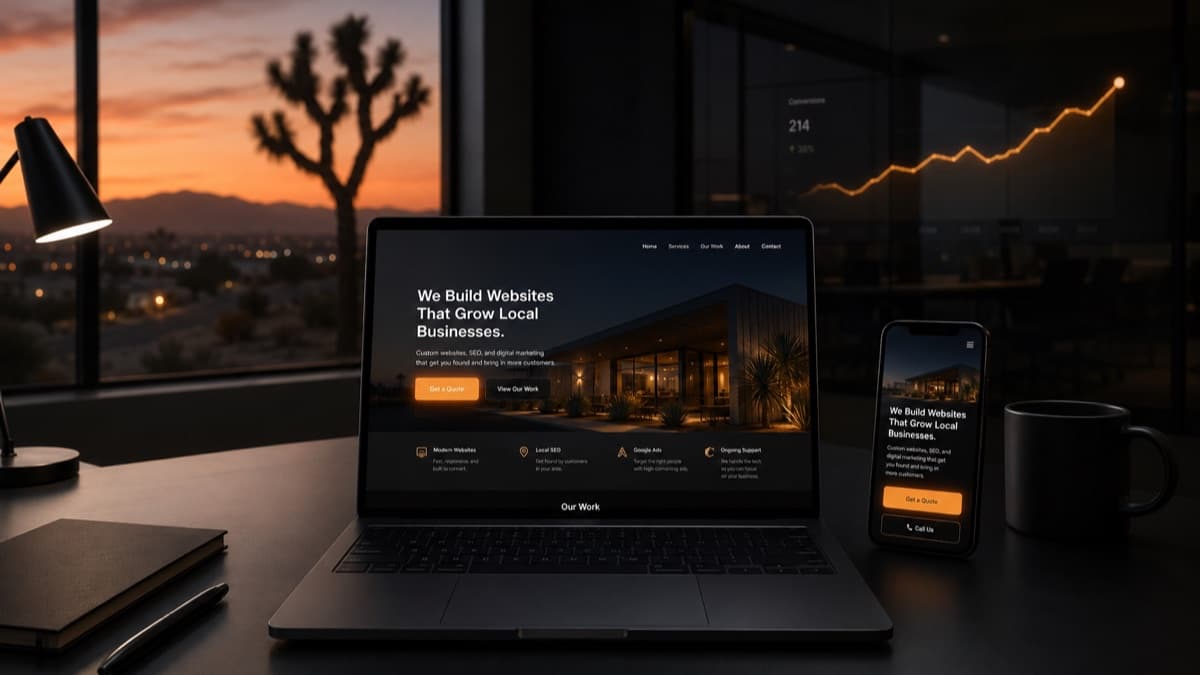
If you've ever typed "why is my website not getting leads" into Google at 10 p.m., you're in good company. Most local business owners we talk to in the Antelope Valley don't actually have a traffic problem. People are finding their website. The problem is what happens next: visitors land, look around for a few seconds, and leave without calling, booking, or filling out a form.
A website that looks fine but doesn't generate leads is one of the most expensive things a business can own. You paid for it, it's live, and it's quietly turning interested prospects into someone else's customers. The good news: a website not converting visitors into customers almost always fails for a handful of predictable, fixable reasons. Here are the seven we see most often.
1. Visitors can't tell what you do in five seconds
When someone lands on your homepage, they're asking three questions almost instantly: What is this? Is it for me? What do I do next? If your headline says something vague like "Welcome to our website" or "Quality you can trust," you've answered none of them.
Your homepage headline should state, in plain language, what you do, who you do it for, and where. "Same-day AC repair for Palmdale and Lancaster homes" beats "Your trusted local partner" every time. Specific beats clever — especially out here, where an HVAC contractor's phone rings off the hook the first week of a heat wave and a homepage that makes people think for even a few seconds sends them straight back to the search results.
The five-second test
Show your homepage to someone who's never seen it. Give them five seconds, then take it away and ask what the business does and how to contact it. If they can't answer both, your headline and layout need work before anything else does.
2. There's no clear website call to action
A surprising number of local websites bury the one thing they want visitors to do. The phone number is in tiny text in the footer. The contact form is three clicks deep. There's no button that says Get a Quote or Book Now above the fold.
A strong website call to action isn't complicated. Every page should have one clear primary action, repeated often:
- A prominent button in the header that never scrolls away
- A clear call to action at the end of every major section
- A click-to-call phone number that actually works on mobile
- A short form that asks for the minimum you need to follow up
If a visitor has to hunt for how to contact you, most won't. This is the core of lead generation website design: the site is built around one next step, and everything on the page points toward it. It's also one of the seven website mistakes costing local businesses money that we see over and over in audits.
3. You're asking for too much, too soon
Long contact forms kill conversions. Industry studies on form length have shown the same thing for years: every field you add gives someone another reason to quit. If your form asks for name, email, phone, address, company, budget, project timeline, and "how did you hear about us" before a prospect has even spoken to you, you're filtering out good leads who simply didn't feel like typing all that on their phone.
Ask for the minimum needed to start a conversation — usually a name, a phone number or email, and a one-line description of what they need. You can gather the rest when you follow up. A roofer in Lancaster doesn't need a homeowner's full project brief through a web form; they need a name and a number so they can get on the roof and quote it.
4. Your site doesn't work on a phone
The majority of local searches happen on mobile — Google's own research has said as much for years. And think about who's searching for you here: a huge share of the Antelope Valley commutes to LA, which means your customers are looking you up from a parking lot, a lunch break, or the couch at 8 p.m. If your text is too small to read, buttons are too close together to tap, or the layout forces people to pinch and zoom, you're losing the exact customers who are most ready to act — the ones searching "near me" right now.
A mobile-friendly website for local business isn't a nice-to-have or a checkbox. It's the version of your site most customers will ever see.
A website that's hard to use on a phone isn't a minor inconvenience. For a local business, it's a direct leak in your pipeline.
5. Your site is too slow
Speed and conversion are joined at the hip. Google's research has shown that the odds of someone abandoning a page climb sharply as load time stretches past a few seconds — and mobile visitors on spotty cell coverage between Palmdale and Rosamond are even less patient. Every extra second is a slice of your would-be leads gone before the page finishes loading.
Slow sites usually come down to oversized images, bloated themes, and cheap hosting — all fixable. We broke down the full picture in why website speed is a revenue problem, but the short version is: if your site takes more than about 3 seconds to load on a phone, fixing that is one of the highest-return changes you can make.
6. Nothing on the page builds trust
People hire local businesses based on trust, and trust is built with proof. If your site has no reviews, no photos of real work, no service area, no faces, and no signals that you're a real, established operation, visitors hesitate — and hesitation usually means they keep shopping.
Add the things that make you credible:
- Genuine customer reviews, pulled onto the pages where people decide
- Photos of completed jobs — real ones, not stock
- A clearly stated service area (Lancaster, Palmdale, Quartz Hill, wherever you actually work)
- Licensing, insurance, and certifications
- A real "about" section with real people
You don't need to manufacture anything. You just need to show what's already true. If you're sitting on a pile of five-star reviews that only live on Google, you're leaving conversions on the table — here's how to turn reviews into your best marketing channel.
7. The site was built to look good, not to convert
This is the uncomfortable one. Plenty of local businesses paid real money — sometimes to a big LA-based agency — for a site that photographs beautifully and converts terribly. Sliders, stock photos, "innovative solutions" copy, and no clear path to a phone call. Design awards don't answer the phone.
Small business website conversion comes from structure: a sharp headline, one obvious action, a short form, fast load times, and visible proof. That's what website conversion optimization actually means in practice — not redesigning for taste, but rebuilding the page around the decision your visitor is trying to make.
The fix is structural, not cosmetic
Here's the encouraging part: most of these problems are fixable without starting from scratch. The issue is rarely that a site needs to be prettier. It's that it needs to be clearer — a sharper headline, an obvious call to action, a shorter form, a mobile layout that actually works, and proof that you're worth calling.
When you fix the structure, the same traffic you already have starts producing more leads. That's the whole game. And it matters more in a fast-growing market like the Antelope Valley, where new competitors show up every year and the businesses with clear, fast, trustworthy websites quietly take the calls everyone else's sites fumble.
That's the work we do at Axtlos. We're a web design and digital marketing agency based right here in Lancaster, building sites for the contractors, home-service companies, and local businesses that keep this valley running — you can see how we work and the kind of results we build for.
Not sure where your site is leaking?
That's exactly what a free website audit is for. We'll go through your site the way a real customer would — on a phone, in a hurry — and show you the specific points where visitors drop off, what it's likely costing you, and what we'd fix first. No obligation, no 40-page PDF of jargon. If you'd rather just talk it through, get in touch and tell us what your website isn't doing for you. We'll tell you why.